~ Estimated Reading Time: 6 min ~
lmao the ps1 rules
The English Translation was finished just two months ago! be sure to check it out HERE!!
Seriously, though! The deeper I get into its discography, the more I feel it etch a permanent mark on my heart. Now, if we're gonna play-pretend console wars; I'm not giving the last word on how the PS2 compares. Those two, above all else, tie in terms of "I'll be finding new hidden gems 'till the day I die". Buuut, I've been noticing something missing in that newer, shinier hardware.
The mid-to-late Nineties' birthed the exact blueprint for the the modern 3D action-adventurer. We basically, uninterruptedly, still make them the way we did in 1998. Equally, though - it was pre-mass extinction; genres newly-born stood alongside the fully-evolved apex species. Yes; 3D amounted much interest in the multi-focused, the widest scopes with the furthest range. And yet, humbler genres had still developed immensely, barely any sign of plateauing. Coinciding with the death of the local arcade as global phenomena, we saw the last big bets placed on the Complexly-Simple game. And just before the multi-genre works would eclipse the sky, the PS1 got to see the Last Dinosaurs.
While technically a duology, I'll be focusing on the latter, more complete entry in the series - Tall: Twins Tower. It's a bit of a Cretaceous reptile; even a team you've never heard of could pump out a razor-sharp package. Many presumably of whom had over a decade of time to learn their tastes through play itself - fat bags of quarters spent on years of puzzle-action. Even staffing newcomers would naturally have strong preferences during this time. And you feel how that taste-making destined even the obscure to bare fangs.
T:TT feels legitimately fresh. Although, the modern sphere shares nothing in common with it. Any indie spiritual-successors seem to skip this prosperous era entirely, opting to throwback to what came before it. Play any late-90s and late 2010s' arcade-inspired oeuvres back to back - it's like the fish that walked onto land, surrounded those who stayed purely swimmers.
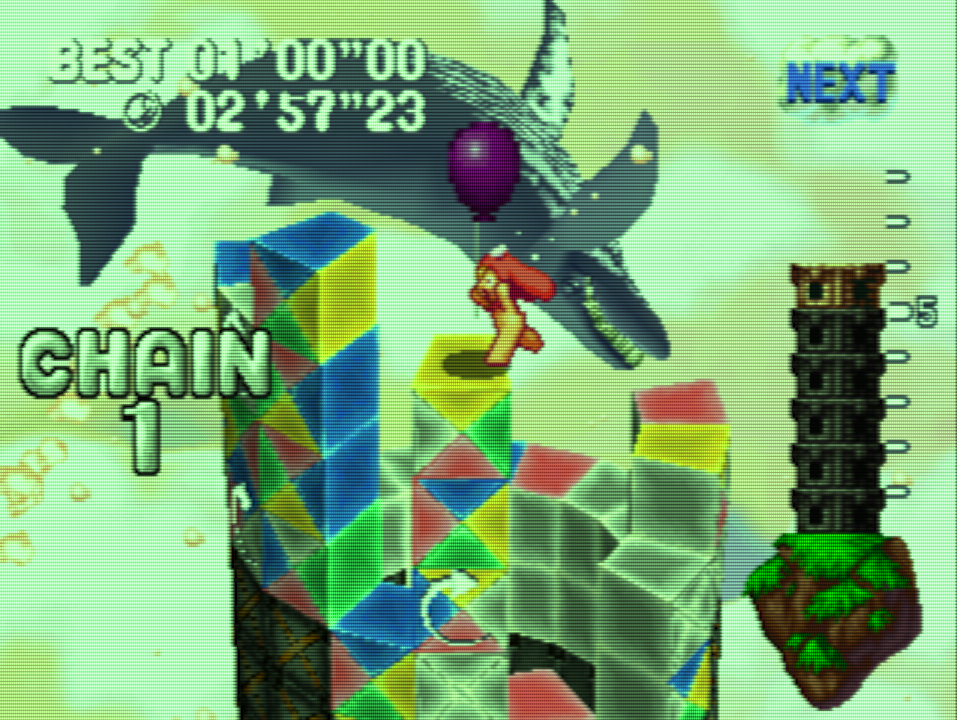
One distinction from prior Connect 'N Match titles is how the player embodies a character. No longer just a mouse hovering: you yourself push pieces into place. Naturally, the play-feel is just going to feel more involving. This evolution must've felt logical, as Mr. Driller made the same shift. Though, glancing at the release date of Tall: Infinity, its near identical timeframe proves that overlap to be of Carcinization. What makes Tall different, though, is what its grounded controls still share in common with the cursor. It has remembered its ancestors.
You're given physicality, but so is everything else. Blocks can be rolled left and right, but can't be pushed up inclines. Try and roll one over a hole, and it'll fill that gap - the drop forcefully detaching it from your hands. While we may not have infinite strength, our nimbleness more than makes up for it. You float down with grace, and snap onto walls with ease. Your usual walking speed doesn't change even at a 90-degree angle, and the animation playfully flips sideways. It's an intentional weightlessness, that, ironically, reminded me of the same hollow-bone-marrow they've been putting in those recent Insomniac action-adventure protagonists.
While blocks cannot scale as great of heights as you can, they can borrow a bit of your force. If you've pushed one over multiple tiles in a row, you can start sliding them up other blocks. It's a small, simulative taste of momentum in an otherwise grid-rigid genre. And, while rotating a square would normally turn it to its next face, the sheer force of going up-hill will flip it an extra face ahead. It's like using a lever to lift something! Finally, we've have developed the capability to use tools.
For another example of Tetris-Structural Betrayal, I'd point out how board management actually works here. We're used to being tested by having limited space: this encourages smart packing, and makes the excess piles known as "garbage" a punishment. But, we're getting into Infinity now; your Tower has endless vertical leeway. Of course, the premise still carries a tension: the floor below you constantly burns away. So instead, building ever taller is the reward.
I am by no means a critic of randomness, but it's interesting - how Tall: Twins Tower puts the player diegetically in charge of their own board. Every time you match two faces of the same colour, a bunch more blocks drop-in. And, while there are algorithmic elements at play there, the newly-born squares always pull from the genetics of the ones from that combo. If your random selections of Tetrominos are like being handed shuffled cards, T:TT is about drawing the symbols onto a blank deck.
It creates conflict between your short-term needs, and long-term wants. It's easy - sometimes, even necessary - to shove two green faces into eachother, and use that to get the ball rolling. But if the other six faces are greyed-out, your board is about to dead-end. While we still share a lot with the UI-selector, one trait lost is our ability to move instantaneously. It is exactly our slowness that makes the tension of rolling a colourful block halfway-across the stage so exciting.
Inversely, you can make a weak hand out of a varied one. One element that stood out to me were the blocks that can only be pushed in one direction. There's a serious chance for the most colourful options at your disposal to be marked with a strain of rigidity. If that's what you're going for, you have to make sure you can actually adapt to the environment you're creating. After all, that preconceived notion of success could go vestigial any second now.
I remember something funny from maybe two, or three days into my attempts at beating Tall: Twins Tower. That evening, I'd recognized that I was struggling with the absolute basis: the block faces. I kept pushing them wrong.
That night, it was an odd feeling. On the the loudest sub-conscious layer of my brain - my mind was idly imagining pushing squares around. My eyes were loosely shut, and my body relaxed - just laying under blanket, imagining them as clear as day. Like an automated process of machine-like picture-processing. I probably looked quite silly.
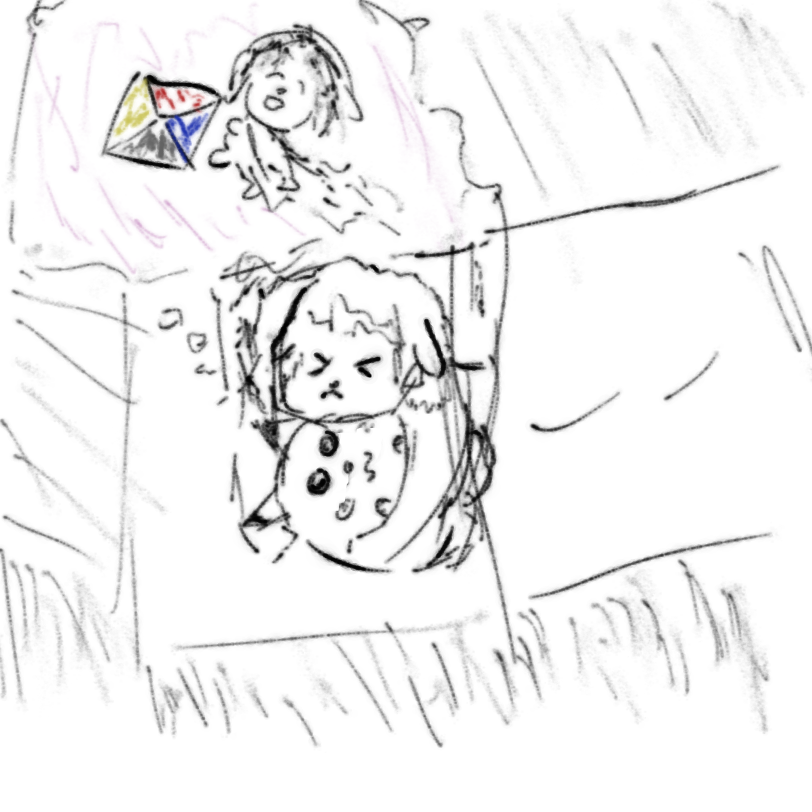
"if i'm standing on the right and i want the blue to touch the floor, i need to roll it...two, no three times....."
I always get intimidated, when I try starting puzzle games. I still remember being a kid, excitedly getting my first rubix cube - thinking it'd come as natural to me as the guys in the youtube videos made it look. And just....totally bashing my head against it for hours, making no progress at all. If there's anything another try put into perspective for me, it's that I've learnt my own limits. I followed a simple regimen to try and beat the game: I'd boot it up for thirty minutes a day, and let my mind deconstruct my flaws overnight. I needed the breaks, I needed the processing time on my own. And then, one morning I just woke up, same as usual, and could just...beat Tall Twins Tower. I guess the best thing I've learned in my adulthood is that I've learned how to learn. The only thing that stops us from growing is we forgot how we grew.
Don't forget history.
| Related Posts | Please enable JavaScript to see this navbox! |
|---|