~ Estimated Reading Time: 7 min ~
Practicing implies repetition. As for when repetition becomes a chore: that's both subjective, and varies between people. We all improve at different paces, after all. If something is static, you can burn it into your muscle memory. But equally, even cerebral challenges may have some optimal sequence of inputs that solve it. Many things can be Simon Says, so where do we draw the line?
The way I see it: there are trappings that lead improvement to feeling like a time-sink. An inevitable success, rather than an earnt one. That may have always been the case; most people's skills steadily trend upwards with time. But being shown the bar-graph in advanced has never excited me. My only conclusion is that Discovery is half the fun of Mastery.
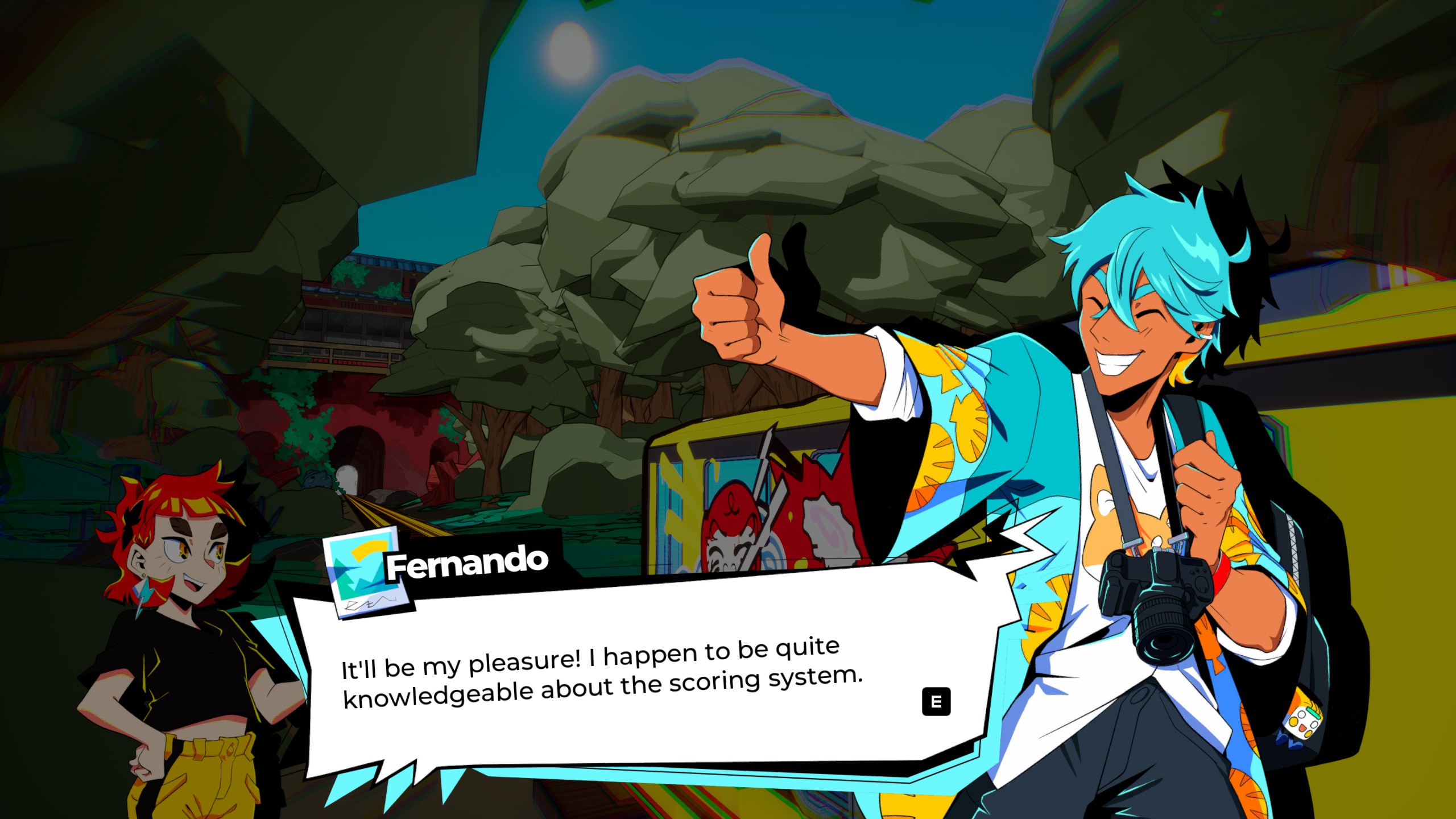
When I get to a stage results screen, and get hit with a "B+"- I'll run it back, and try and get the highest letter I can. I've spent hours on Level Ones. That way, I'll know what skills I'm asked of for the rest of 'em.
In Denshattack!, every place you can move on is laid out in front of you. Train tracks don't wiggle. You can't hug the corner of them like a road. In a racing game - sharp turns may be telegraphed with neon-signage, but the way you drift can have a million outcomes. In Denshattack!, drifting has been simplified to holding down a button as a gauge suggests, and releasing it at the "Perfect" time. By their nature, trains are going to feel more on-rails.
Every hazard is telegraphed with loud pop-ups covering the screen, as if the legibility of your surroundings weren't enough. Even things we associate with easter eggs - like waking up a bunch of bats when you honk your horn in a tunnel - are tasks you're reminded to do. The only decisions this leaves you to figure out are when it's safe to break out those Tony Hawk-style tricks. Which are fun and nice and all....but are still telegraphed, just instead by the absence of warnings. They're easy to break down into self-critiques of "now i know what to do next time". My brain was always ahead of my fingers - I found that demotivating.
So, I gave up on my approach, opting to play each stage once instead. And, what can I say; the game gets better. It builds on its kinesthetics. Pop 'N Music may just be pressing buttons at the right time, but those buttons are huge enough to make your wrists flick around. It's like learning where to rest your fingers on an instrument. Similarly, my fav bits of Denshattack! are physically sensational. Like swinging off back and forth on a monorail, and detaching at the peak of an arc.
And when I thought I had gotten to the good stuff, I tried practicing one stage again. What I learned was that I disagree with its definition of quality play.
I've been into Sonic Adventure 2 this year. Ahh, now that's a Dreamcast game!
All of your actions are weighed under the uniform metric of Score. Doing a combo on a line of enemies, picking up rings, or finding secrets - stage completion time is just another factor amongst many. Sonic can leap over canyons, but big numbers aren't just about skipping. They're not not about skipping, either; your skips just have to save so much time, it outweighs the value of what you could be doing instead of not doing.
When I started watching some skilled player's recordings, they would perform tech so tight, that it might be tougher to replicate than to just...get an A Rank off fundamentals. Rankings calculate skill like a report card; they say "73% in speed, but 94% in riding down rails", which averages out to a passing grade.
Denshattack! is not like this. The aesthetics of being marked across multiple categories are there, but that's where similarities end.
If you beat a stage with a Gold Medal in Score, but a Bronze Medal in Time: it's the game's way of saying "you tricked well, but at an inefficient pace". If you go back, and beat the stage much faster - but overcorrect, and forget to do tricks - the game will...remember one of your previous attempt's best Scores, and show you've earnt two Gold Medals total?
Each stage has seven to nine side-objectives, and completing them all results in a third Gold Medal. They'll be permanently marked as complete; you can do one dare per stage-clear, and it'll eventually amount to that third medal. These being named "Dares" is misleading: there's no incentive to allocate risks to them during your speed-runs.
This rewards repetition more than its contemporaries. It has higher standards for its categories, because it wants you to get perfect at them in isolation. It has no room for the median success. It's optimization sanded down into a collectathon.
The biggest indicator Denshattack! isn't confident in this structure has to be that it's like...twelve hours long. One of the great things about Ranks are how they teach you how to get a lot out of a little. Ultrakill was beloved when it was minutes long - that stayed true over update droughts, because "go learn & grow & stuff" is a great way to make time go by. Denshattack! spreads its ideas thin across seventy stages, even though you could get an infinite amount of time out of only one. It leans into first-time-seeing spectacles, even though you could see them ten, or twenty, or thirty times. Maybe, it was 'cuz they knew they didn't give us a good reason to go back.
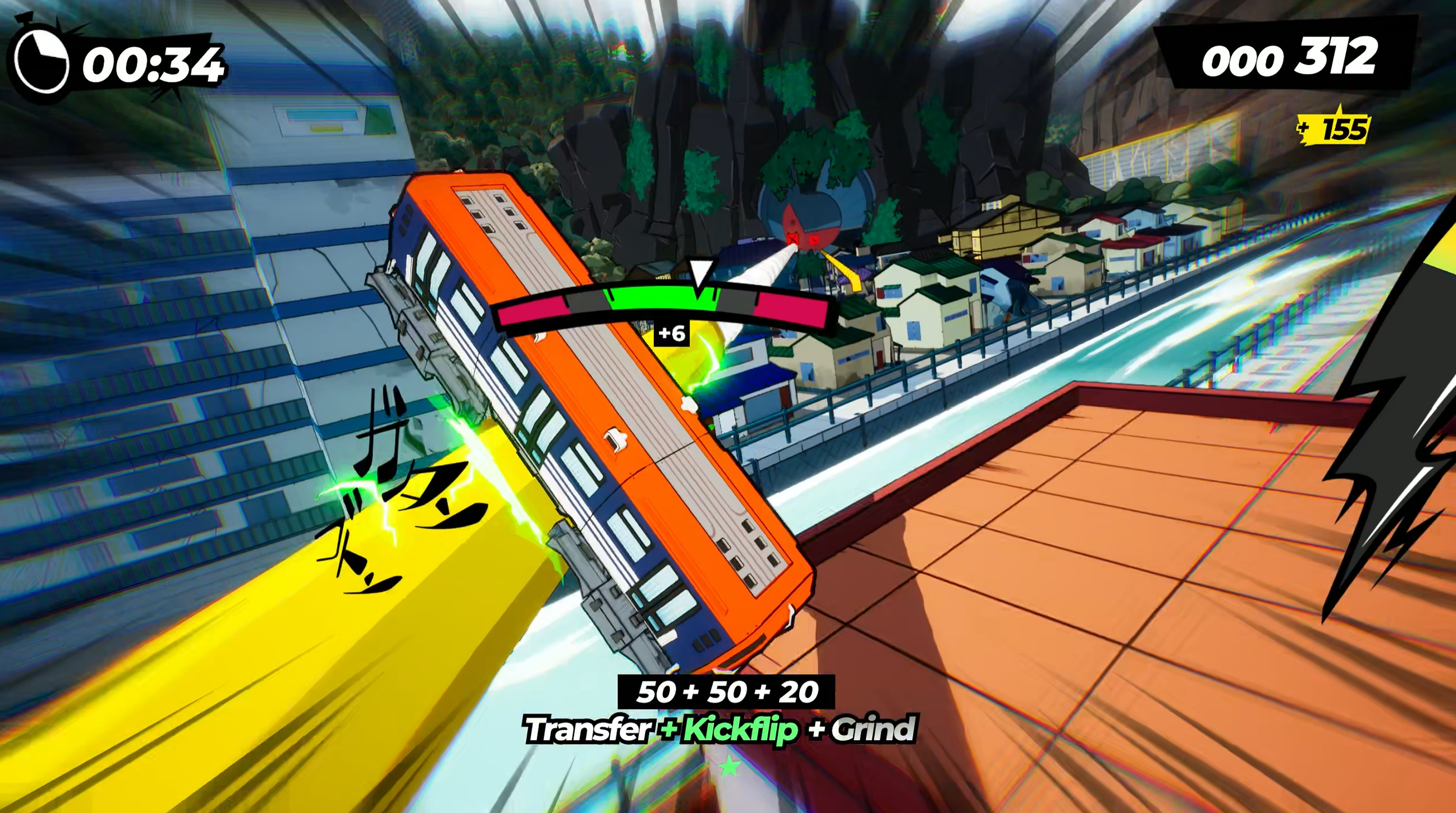
There are seeds planted for alternate measurements of skill. I was particularly a fan of the "Delivery" maps. Three-way forks in the track drop you into looping circles. You complete the goal that breaks you out of one, and sift back through the others. It has a self-conducted rhythm, well-aligned with the setting itself: you play as a lower-class chef servicing the commonfolk. It's where its pathos blends into the play best. They were the stages most incompatible with ranking; you can just infinitely trick in loops, and save the other medals for later. But also, these were the bit most satisfying to complete on their own merits.
Hm.
I wish we took these trains more seriously.
Anime being melodramatic and absurd in the same breath - it's something I've always loved. Some of us had teenage-phases where we stuck our nose up to weirdness. Now, though: it's earnesty era.
Denshattack! is a love letter to sincere works on the surface. But the titular Densha never find their footing as a metaphor - instead, script-time is spent on silly anime rival pastiche. Gurren Lagann didn't pick Drills as a non-sequitor.
So, when its second act pivots into us taking the role of the outlawed, forced to revolt - it didn't sit right with me. Despite the climax criticizing neo-fascists and AI, the protagonists are like rock-stars: famous artists fighting back against The Man. It's the way we've portrayed underdogs since the '70s, but provably isn't applicable to the modern world. It's an inspiration, but it should stay simply that. After all, isn't "remember the good ol' days, when stuff was actually cool?" exactly what the antagonists would say?

Despite the criticism, I have no interest in implying that Undercoders are a team of fake-leftists; they gave an aura-farmer top-surgery scars, they're prob cool
I am not a woman of high-taste. I like pulp, and other juices. At the end of one boss battle, your train shoots through the heart of a bigger train - like how Goku killed King Piccolo. Yep, I smiled. I'll admit it. There were dozens of guest-composers on this, and I'm probably one of the only people who were most excited for Harumi Fujita's contribution. These developers share taste with me!! But, when everything about Denshattack! reminds me of something else, it doesn't have something of its own I can remember it by. And when reviewed as a derivative, it's under-studied on the works it's worshipping. I could imagine many of these ideas shining, if given a foundation built on first principles. I'd like the developers to work on their expression of themselves, rather than their interests.
| Related Posts | Please enable JavaScript to see this navbox! |
|---|