~ Estimated Reading Time: 6 min ~
I always hear stories about people feeling free in their lucid dreams. When I think back to it; the only time I ever had one, I just said to myself "let's get outta here", and woke up.
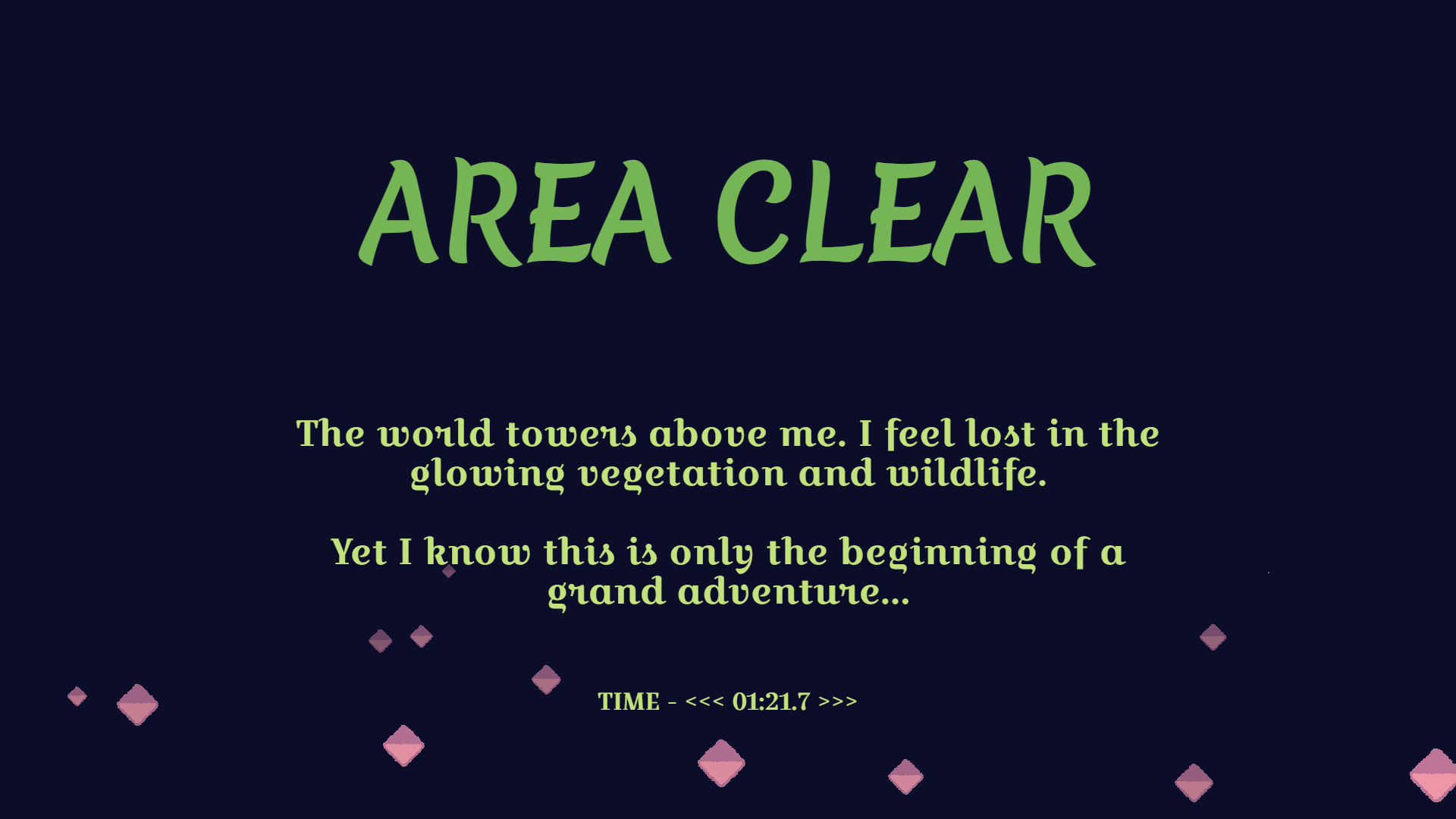
09 - Waking Forest
From name alone, "Platformer" has always implied relation between the player, and what they're standing on. From the moment you jump - your feet leave the earth, the thin atmosphere being the only remaining element that could touch you. To then force the player to once again acknowledge the ground below, is your only tool to ground them.
Following a genre name like a guidebook rarely helps anyone, but balancing the strength of player options is a legitimate design tension. For every hover, stall, and parachute you're given - you've been granted the agency to distance yourself from your surroundings. The core conceit of jump arcs is aiming a rise, and then a fall. Double jumps, for example, allow you to reverse that trajectory at any point. Air-dashes, and their momentum provide opportunity for creative solutions. But, when you're allowed to bypass too much, it has detethered you from the stage's gravitational pull.
These are all expressive, sure - but expression can sand down spacial awareness. I love fucked up movement! But I've struggled to connect to the schmoovement-sandboxes coming out of indie scenes. Skipping sequences can indicate a high skill-ceiling, but they can also just mean we're overpowering the environment.
10 - Sedimentary
A developer who rejects trends could lean towards limitation - conservatism. But what impressed me the most about Somnabuster, was how its breadth of actions complimented its groundings.
In its first area, a young forest grows taller and taller. Dolores has a double jump, but using it to suspend yourself in air would only cause you to fall behind. Its vertically-sprawling structure rise so high, you're forced to play catch-up. And when you expend your vertical movement in the perfect spot, and manage to poke the ceiling - you snap right to it!
Walking upside-down is a fantastic pull. What we'd usually expect is to scale a world through its ground - maybe even its walls - but for ceilings to represent the limitations of your ascent. Instead, Somnabuster presents it as but another footing; not limitless, but another way to move at your own pace. You have an air-dash, but more reminiscent of vaulting through air: it holds for a moment, suddenly slinging you, and ends with an equally sudden halt. You can't jump out of it, so the only way to keep that momentum up is to perform your aerial attack afterwards. Fighting against the obstacle course, you bounce off the terrain with a spin. It's your sole option for perpetual motion. What we commonly associate with the Marios and Sonics of the world, is that top speeds are maintained by avoiding your surroundings' interruptions. Somnabuster is unique, because it is instead about - like a plane, jetting its engines down the runway - pushing off of the floor to lift-off. You keep doing this, even as the terrain shifts in weird angles - almost like you're being pulled by the stage's orbit. At its fastest, you do not provide your own speed; you're small, the world is huge, it takes you where its whims take the earth. This quote from the game's creator puts it succinctly:

25 - Blessings From A Nihilistic Power
I'm reminded of a fav director of mine: Hideo Yoshizawa. Many have made platformers sharper, but he had this knack for tonality. It was probably by necessity; his work on Ninja Gaiden predicated how we punctuate action games with cutscenes. But, still!! It got the vision for how the motion interplays with the aesthetics interplays with the narrative interplays with the action.
(ʇno sǝɥʇɐǝɹq 'uı sǝɥʇɐǝɹq)
A ninja making precise hops with certainty, always going for the neck. Any faltering confidence, and he's left outnumbered. Later in his career, he stayed consistent in a completely different direction: Klonoa: Door to Phantomile. Its puzzle game-y rhythms lack a certifiable pace. And it supplements that with a dreamy journey, hazily wandering.
When you take a break from tricking around, you'll notice that Dolores isn't a fast walker. I mean, she isn't slow - though, maybe it's her capability to work quick that makes it easy to think otherwise. You're constantly starting and stopping. Hastening, and running out of breath. It feels like she's always lifting off, trying to take her first flight.
uncertainty
63 - Presumed
After you take down your first boss, Dolores is met with this sudden anxiety. She's doing things for the new time, and it's confronting. A bit later, her perception of the logic of the world she's gotten stuck in is suddenly shattered - she panics at the party, surrounded by guests. And after being faced with grounded conflict oncemore, she silently runs away.
Uncertainty
Your melee-aerial is hard to get a grasp of. You might be moving smoothly with it for a moment, but a sudden dip in angle on the dirt slows you down entirely. It's the world that controls your pace. The mechanics of Sonic games' boost pads are borrowed, but paint the mood instead as loss of control. Being pulled by something is scary. It's being on a leash that makes you feel like a kid again.
UNCERTAINTY
17 - Seeds of the Heart
When writing Klonoa, Yoshizawa wanted to tell a story that dealt with difficult topics, while conveying itself simply. It was not a story for adults: it's to help children process emotions they might not have the language for. Something to play back in their head as they grow up. I think he'd be happy to know a story like Somnabuster's exists: one that evokes overlapping analogies, but instead processing the similarly confusing pains of young-adulthood.
I feel I often think that I am experiencing feelings for the first time that others would have in their teenage years. Wondering when or if I'll ever stop feeling stunted. Afraid I'm falling behind my peers. That my worth is being measured, and defined as 'low'. That I just want to restart. Somnabuster, I think, is speaking from a language I'm very familiar with. And I don't think that uncertainty will stop hanging above me for a long time - because my adulthood is not close to being over. The dream depicted in Klonoa ends, because an adult knows how life-changing it is for any child to encounter such a feeling. It is, in a sense, the end of childhood. Somnabuster speaks from an early 20s-youthfulness of having encountered new dreams - new reasons to live - but having not yet seen the conclusion to following them. We haven't woken up yet. So we can only hope.
But, if the existence of such a work, made by someone of around my age, is any indication...then self-actualization cannot be impossible. I cannot say a single indie game has ever motivated me about the sheer possibility that I could follow in my peers' footsteps as much as Somnabuster did.
Now, take my hand. Let's take one last first flight together
| Related Posts | Please enable JavaScript to see this navbox! |
|---|