The Legend of Zelda
~ Estimated Reading Time: 10 min ~
Good evening, everyone! Today, I read the manual for The Legend of Zelda for the first time.
We are far past the context. I didn't grow up with this game - I grew up with emulators. And for whatever reason, it took me all the way until after finishing the whole thing to look up a scan of what was in those packages I never got my hands on. The game has this mystified reputation of the whimsical 'purity' older games once offered. But in a sense, that definition has only became exaggerated with time.
But, I wouldn't like to portray this experience as a misrepresentation of the past, either. We are simply walking in the footsteps of handmedown-isms - of juice spilt on paper, cartridges handed down by older brothers, or yard sales selling incomplete materials. To play aimlessly - like a child who wouldn't have known better - is as tried and true as you get. And I guess what I found interesting about The Legend of Zelda was how it played into its feeling: of how the verbs of play themselves bared a blank slate. In that sense, it is the most earnestly child-like adventure game I've ever played. For without backstory, Link is just a stand-in for the plainest of youthfulness - kicking around rocks, wandering of our own volition. I found myself getting emersed in exploring a world that had nothing to do with me. That wasn't for me.
"I wanted to create a game where the player could experience the feeling of exploration as he travels about the world, becoming familiar with the history of the land and the natural world he inhabits. That is reflected in the title: “the legend of ____”
Adventure games and RPGs are games where you advance the story through dialogue alone, but we wanted players to actually experience the physical sensation of using a controller and moving the character through the world."
-Shigeru Miyamoto, 1994
In the preceding months, I've developed a bit of a fascination for Miyamoto. I have no interest in venerating his person, of course; he's been a corporate manager for 30 or so years, he's probably kindaaaaa evil. But speaking purely as an artist, ESPECIALLY in the early 80s - he was a mountain of resonant quotables.
Especially when paired alongside mythology of how getting lost in local caves and woods inspired him - there was one topic he frequently discusses that reflected the most in Zelda. When he explains what it means to be inspired by the real world, he often frames it through the comparison of "realism", versus "reality". To love one, but despise the other may come off as contradictory at first, but he always puts it so gracefully. To him, realism is about following a set of rules that superficially mimic reality. Reality as a frame of reference, however, is the impressionistic approach of converting feelings often found mundanely into a language of expression. And I found the way its oddball rules become such a natural language to be admirable.
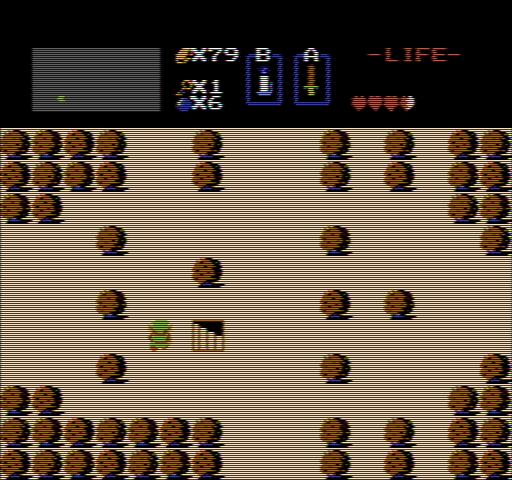
Zelda 1 ain't an easy game! If I'm being honest, I got lost a whooole lot - especially early on. And when you're walking from innocuous paths in repetition, you begin to get curious. It has its own ways of sparking your eye for experimentation. Later Zeldas would emphasize logic in its secrets-spelunking; you see an outpost with a big red mark on it, and you think to yourself "well, I guess I gotta get something to shoot that". Every room carries a specific purpose, gifted for your powers in specific - and a world that exists for only yourself will always feel artificial. "Video game-like". But Zelda 1 is much more stripped back; your ways to interface with your surroundings mostly come down to your Bombs, and Candle. You can only carry a few bombs at once, and your candle can only light one fire per room - meaning that your experimentation per room is limited in multiple ways. And vice versa, the types of secrets you can find with them are both plentiful, and relatively randomly placed. That limitation confines you to a pace in which you can't keep bashing your head against the wall - but instead, to play to your own whims. Try what may work when your eye sparkles.
There was this one time I found a room with two giant mounds of rock protruding out of the ground. I guess it technically would've been the second and third - I had seen a structure exactly like them prior, but bombing it bared no fruit. But for whatever reason, I decided this time, it was just too suspicious to ignore. But alas - I only had one Bomb left - so I could only take a guess at which of 'em would be the answer. And just my luck: the one I had chosen to bomb was an entrance to a whole Dungeon! The uncertainty of any turn-out, in combination with sacrificing the last of something precious: the excitement was incredible!! And while certainly not "clever", I...think that type of arbitrary placement has a place. Nature doesn't follow clever rules either. It grows, and grows, and for it to lack concise purpose is for it to exist for more than just you. Walking into a forest really screams into your mind how much the wilderness isn't "built for us" in the same way urban pathing scapes are. Zelda games would build their worlds taller and taller, but never since the original have they felt so much larger than us.
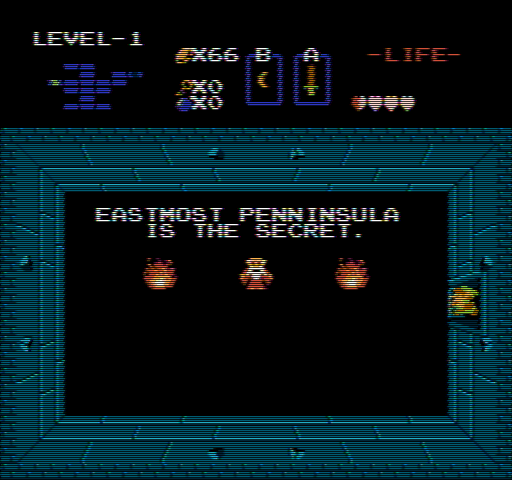
And on one hand, you feel that disinterest in realism: Zelda 1's personality is ridiculous!! After making no progress in one of Hyrule's mysterious meadows, I innocently burnt open a random patch of trees, only for a pair of stairs to lay beneath. Oh, that's gotta be progress!! And once I stepped in, I was greeted by an NPC who would go on to say "Pay for the door damage repairs." and automatically took 20 rupees out of my pockets. Even now, I kinda giggle thinking about it. But the verbs of play painted by moments such as this are quite grounded, in a sense. The risks and rewards in that tender mundanity reminds me of the same impulse we have as kids, tearing up grass, lifting up rocks. Maybe there's something genuinely dangerous, like Spiders and Snakes, lurking in whatever broken stump we reach our hand into. But maybe there really is some treasure beneath one of these....at least, that's what our imagination told us.
Oh yeah...one of those stories you always hear from the oldheads is about how back in their day, you used to have to map the games out yourself with a pencil and paper. And while I've dabbled a bit, and wrote plenty of notes, I realized that I've never fully mapped a world out like that.
Uhhh....so yeah. I did it.
You wanna see?
Uhh.... okay..
Umm...lemme just
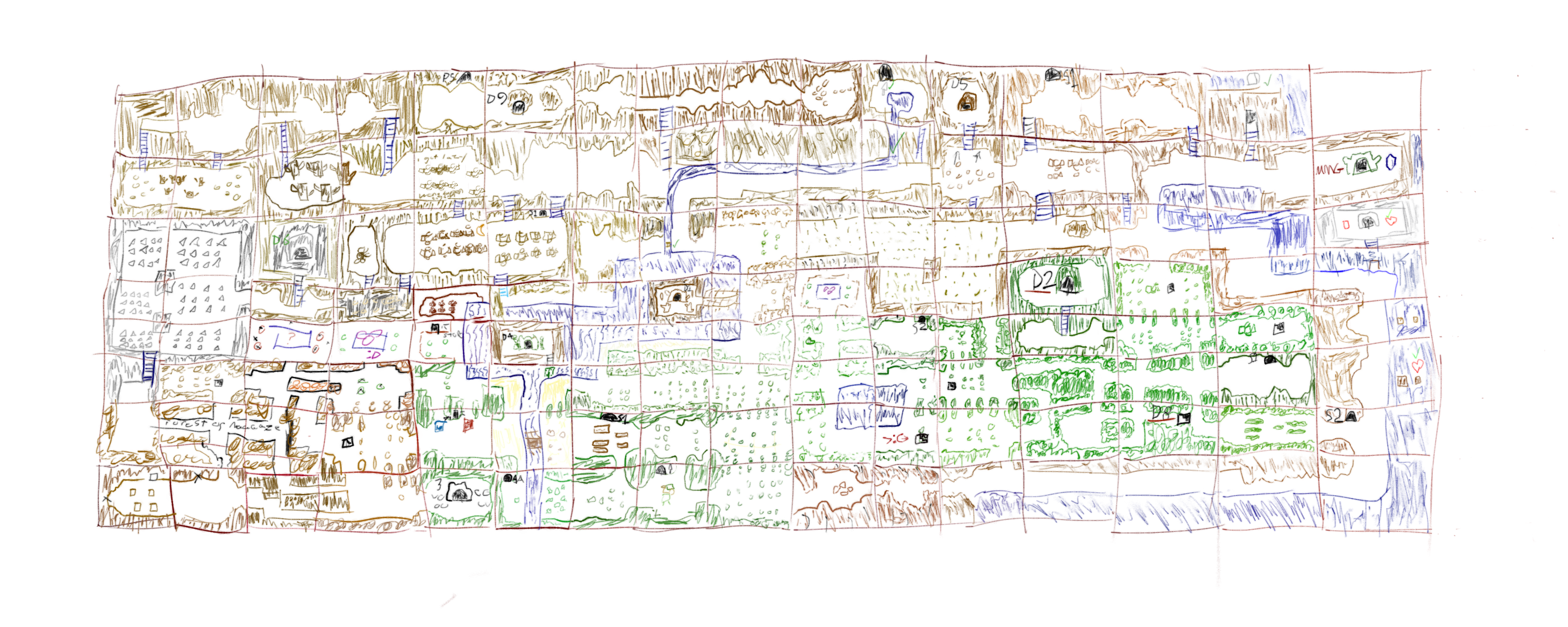
dah dahdahdah dahhh. +13 rupees
yeah it looks like butt :p
I had lots of fun, though!! And, I'll admit: I don't know if the reverence towards this playstyle as necessary holds up. It must've shaved off as much time as it saved. My friend faea played the game alongside me, but without mapping - she defeated The Redeemable King Of Moral Greyness a few hours before me! And at first, I guess I only had a little to chew off in appreciation. But then...I started noticing something. I just kept thinking about... how...natural Hyrule is.
You see it too, don't you? You zoom it out, and you can see how much narrative is packed into it. How sensical the wall borders are for an NES game, how many rooms that are seemingly purposeless on an individual level serve an ecological function. Every shape is apart of a larger shape. For a game in which you're always only seeing exactly one static room, no room is singular. As I formed the map, the map itself began to subtly nudge me. I was able to write off which rooms made sense, and which felt off. And from there, the aim of my bomb became more focused.
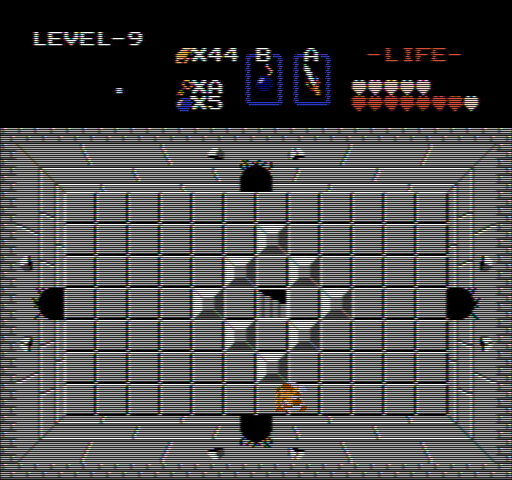
That unique feeling that everything just clicked in a way the later entries don't quite look up to applied to Dungeons, as well. We all know the formula of later Zeldas: you enter, you fight and puzzle, you get a new tool that transforms how you interact with it. It's an RPG-like satisfaction as your versatility improves, and you become "more powerful". But I think Zelda is a much better RPG when your power, and the dungeons are separated! I had this revelation around the 4th Dungeon here - I just wasn't strong enough to get to the end of it! But I was exactly capable enough to find a new tool within it - one that ironically didn't do that much within the dungeon, but transformed the outside world. So, when I left to recuperate after a staggering loss, I managed to find multiple upgrades, all of which empowered my next attempt. There's a more earnest fluidity to how one may take each loss as an opportunity to retrace your steps, and find a new something.
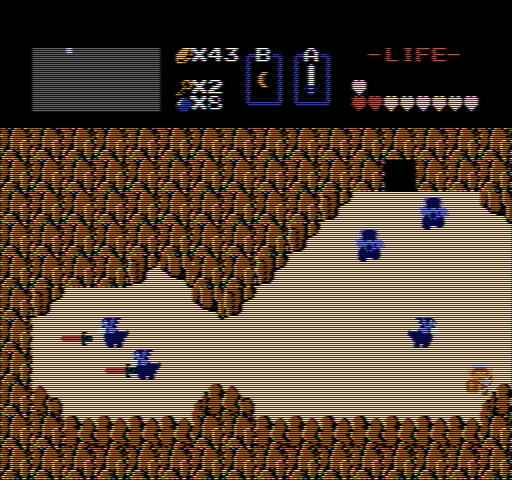
Ironically, the worship of Miyamoto's childhood influences can often bely how contemporary his games were. Zelda 1's combat is dripping in blatant pulls: from the mages doing their best Galaga impressions, to borrowed experience from the team's time porting Kung-Fu Master. The RPG elements allow for its combat to get overbearingly messy - that style of randomized enemy behavior, that requires constant awareness of their unpredictable repositioning. But that's why it's rewarding to balance that difficulty out with your grab-bag of skill and upgrades. Link to the Past's rehauling would emphasize a cleaner problem solving process - which ironically means that it's much more clear how one would beat a series of enemies flawlessly. The more "puzzle-like" you make Zelda, the easier the path to permanently "solving" situations becomes - which ironically devalues all those health reserves you work to discover.
While Breath of the Wild worshipped its great grandfather's freedom, I think that's what it really missed. Zelda 1's "Freedom" was in being able to do anything, but that each player would need a different mix of strategy and tools at their arsenal to clear any of its everythings. Meanwhile, its successors would place emphasis on being able to do more things than any obstacle could really need or encourage. A million ways to take out a single Moblin. Even clearing Calamity Ganon early into a playthrough can be broken down into a series of perfect dodges and parries. You could look at the surface of a truly open game like Zelda 1, and assume that its philosophy was that there were no rules. But it's as free as it's untamable - because that was a believable enough reality to be compelling. Freeing realities don't lack rules; even playgrounds have bars.
I guess that's why I don't know if The Legend of Zelda is that good of an example of a "pure" game. By the end, everything I loved about it was in its opaqueness. Its unsolvability. It made me want designers to worship its strangeness more often. My gut tells me that while it's frequently gestured towards, not many have replicated its totality. And....I guess I just really had fun playing it. I don't often say that part out loud! I guess all I needed to love it, was to doodle, and mess around. Maybe, it's less that there's something uniquely authentic to The Legend of Zelda, and more that it's great at bringing out authenticity in us.
| Related Posts | Please enable JavaScript to see this navbox! |
|---|